
Unmul Public Lecture, Geography Education, Mulawarman University, Food Security, Climate Change, Geography Students, Climate Action, Future of Food, Geospatial Insight
29
Juli
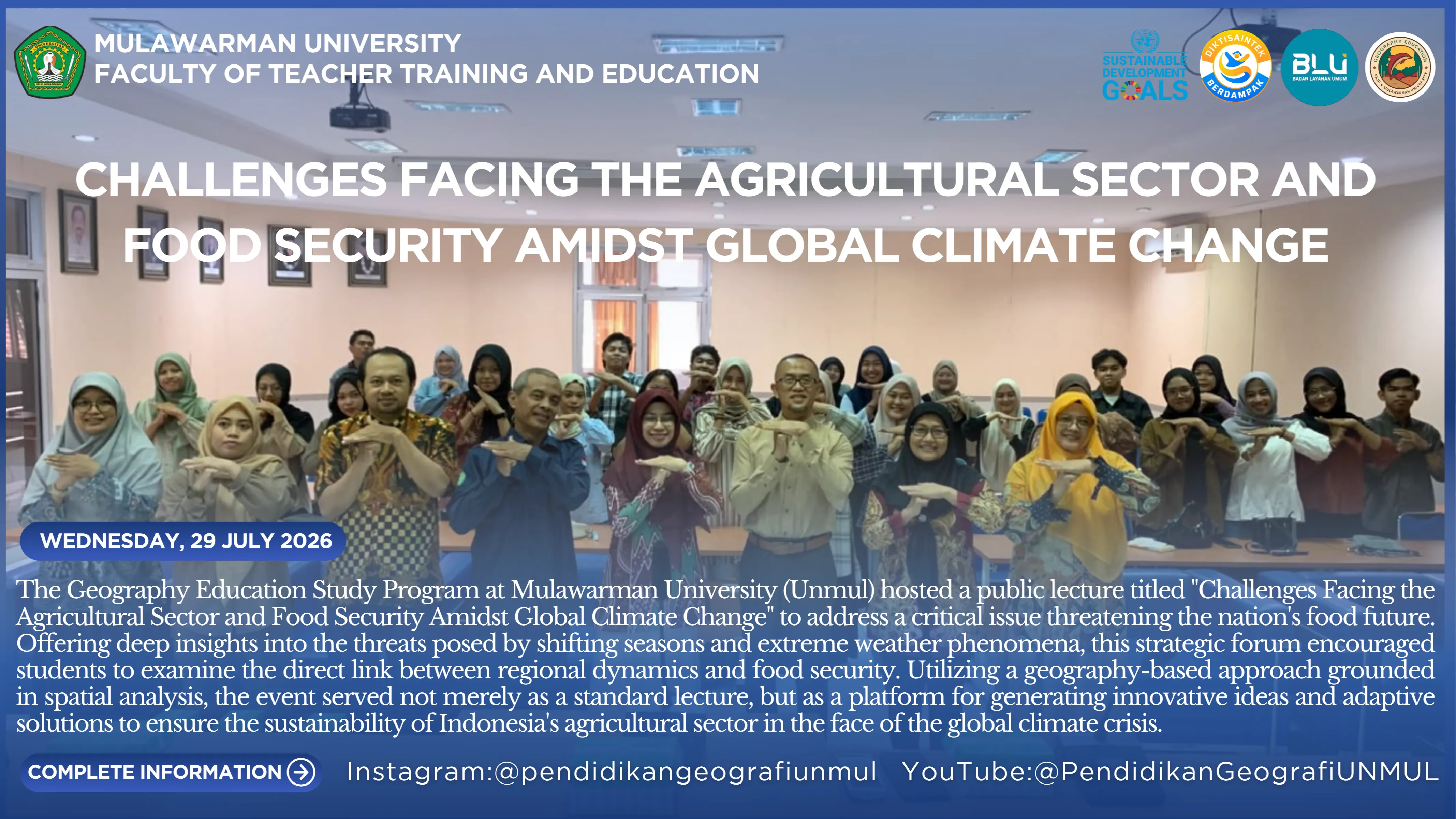
**SAMARINDA** — The Geography Education Study Program at Mulawarman University held a public lecture titled *"Challenges Facing the Agricultural Sector and Food Security Amidst Global Climate Change"* on Wednesday (July 29). Conducted in an interactive format, the event served as a crucial platform for academics and students to examine the climate crisis, which increasingly threatens the stability of the global food supply.
Climate change is no longer merely a theoretical concept but a tangible threat directly impacting the national agricultural sector. In the keynote presentation, the speaker highlighted how shifting seasons, heatwaves, and extreme weather events disrupt planting patterns and trigger crop failures across various regions. Without rapid adaptation measures, community food security faces significant risk.
A geographical perspective provided a comprehensive viewpoint for mapping areas most vulnerable to the impacts of this environmental crisis. Through spatial analysis and modern mapping technology, participants explored the importance of geospatial data in designing mitigation strategies and identifying food commodities suited to changing regional characteristics.
Beyond analyzing the threats, the lecture sparked lively discussions on formulating sustainability-based solutions. Ideas ranging from precision agriculture innovations and local food diversification to efficient water resource management emerged during the Q&A session between participants and the speaker.
By hosting this event, the Geography Education program at Mulawarman University reaffirmed its commitment to fostering a generation of critical and adaptive young people. It is hoped that the ideas and analyses generated in this academic forum will serve as a foundation for concrete student action in supporting national food security amidst global climate uncertainty.